
Key points
- ✓ A result outside the reference range may or may not indicate a medical condition.
- ✓ Units, method, preparation, symptoms, and medical history affect interpretation.
- ✓ Do not change medicines or start supplements based on one number alone.
What an abnormal result means
- Reference ranges describe values found in a population and may differ between laboratories, ages, and other groups.
- A healthy person may occasionally have a value outside the range, while an in-range result does not rule out every health problem.
- Some tests provide guidance, some monitor a condition, and others require confirmation before a diagnosis can be made.
- Meaning depends on why the test was requested and how it relates to the examination, symptoms, medical history, and other studies.
What to check before comparing results
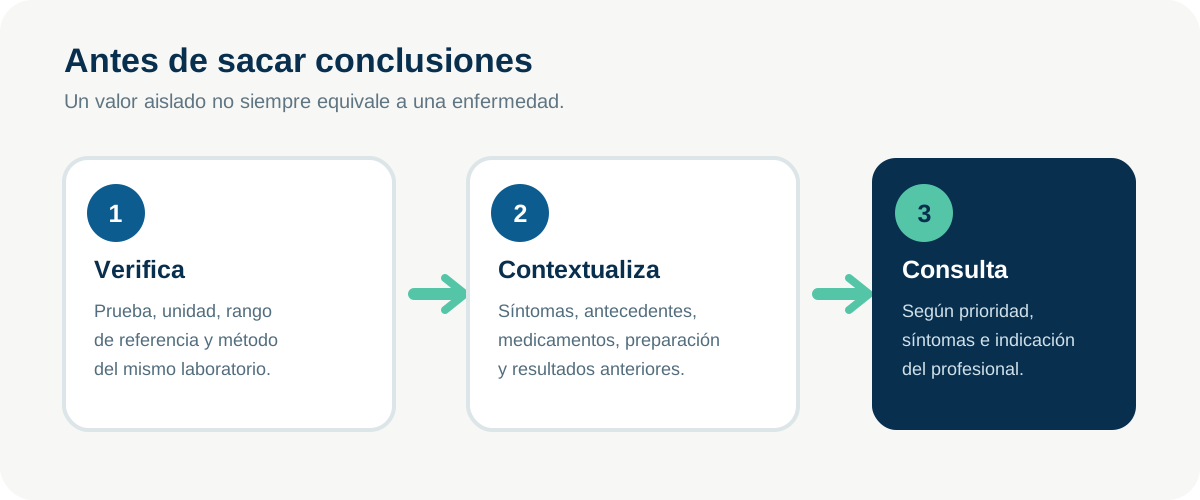
- Confirm the exact test name, unit, and reference range printed by that laboratory.
- Check whether you followed preparation instructions and whether exercise, menstruation, dehydration, fever, or another circumstance may have influenced the result.
- Record medicines, vitamins, and supplements; do not stop any of them without professional advice.
- To assess trends, compare equivalent tests and, where possible, methods and laboratories that are comparable.
When to discuss results with a doctor
- Arrange review when the laboratory flags a critical value, a clinician requested close follow-up, or the result relates to current symptoms.
- Advice is also appropriate when several tests are abnormal, there is a major change from previous results, or pregnancy, kidney, liver, heart disease, diabetes, or another relevant condition is present.
- Bring the complete report rather than a cropped photograph of one value, together with earlier tests and a medicine list.
- A clinician will decide whether observation, a repeat test, or further assessment is needed; not every abnormal result requires treatment.
When to seek priority care
- Follow the laboratory or clinician's instructions if they contact you about a critical result, and do not delay the recommended assessment.
- Seek urgent care if the result occurs with chest pain, breathing difficulty, confusion, fainting, seizures, marked weakness, or major bleeding.
- Persistent vomiting, inability to drink, little or no urine, and rapid deterioration also require prompt assessment.
- Urgency depends on the combination of results, symptoms, and overall condition, not on comparing one number with generic internet information.
Warning signs and when to seek care
- A result reported as critical by the laboratory or treating clinician
- Chest pain, breathing difficulty, fainting, confusion, or seizures
- Marked weakness, persistent palpitations, or rapid deterioration
- Major bleeding, black stools, vomiting blood, or marked pallor
- Persistent vomiting, inability to drink, or a marked reduction in urine
What not to do
- Do not self-medicate or start supplements to correct a number without assessment.
- Do not compare results from different laboratories without checking units and reference ranges.
- Do not stop prescribed medicines because of one isolated result.
- Do not ignore a call about a critical result or wait for social-media advice when serious symptoms are present.
Medical references
MedlinePlus — Understanding laboratory results MedlinePlus — Laboratory tests MedlinePlus — What to know about blood testsIf you have symptoms, risk factors, or questions about your situation, arrange a professional medical assessment.
Book an appointment